The purpose of this report is to provide solutions for an issue identified by DWAF, e-bike modifications that lead to speeding and other accidents. The proposal covers the background of why e-bike accidents occur, and goes in-depth on how implementing the ESCS will help reduce accidents and improve road safety.
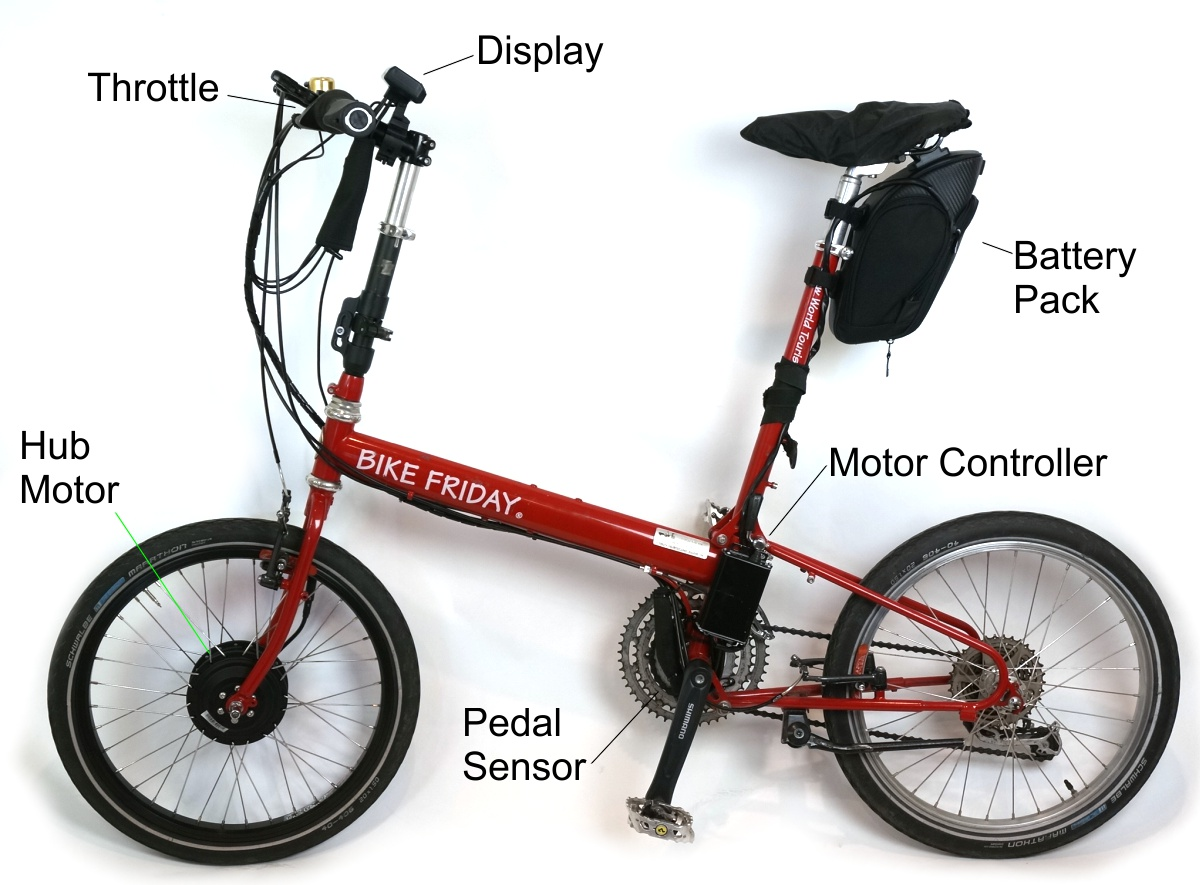
In this report, we will explain the main components found in an e-bike as shown in Figure 1.1 along with our proposed solution to install different sensors for measuring and monitoring the speed of the e-bike. One key objective of our proposal is to reduce accidents regarding modifications that lead to illegal speeding while ensuring road safety for all road users.
As there is an increasing number of power-assisted bicycles (PABs) also known as electric bicycles (e-bikes) users and e-bike related accidents, our team have come up with this proposal to introduce the implementation of a speed control monitoring system. In our proposal, the team will be giving an in-depth analysis of how an e-bike works and how implementing an E-bike Speed Controlling System (ESCS) will affect road safety. Also, explaining to the Land Transport Authority (LTA) how to generalise the installation of ESCS.
Figure 1.1
Components are found in an e-bike.
Note. Adapted from GRIN TECHNOLOGIES (n.d),
https://ebikes.ca/getting-started/ebikes-parts-explained.html
Background
In 2016, Singapore's government adopted the recommendations of the Active Mobility Advisory Panel concerning cycling and the use of Personal mobility devices (PMDs) and e-bikes. The measures include expanding the cycling network and its supporting facilities to meet challenges in public safety arising from the use of PMDs and e-bikes. PMDs and e-bikes have gained popularity in Singapore due to their convenience, efficiency, and affordability for short-distance travel. As PMDs and e-bikes are becoming more popular, it has started to spark fears over public road safety.
Following COVID-19, more people are working from home which in turn increases the demand for food delivery services. Consequently, many e-bike users are using their e-bikes to do food deliveries, said Mr Jin (2020). In tandem with the spike in e-bike usage, traffic accidents involving e-bikes have risen in Singapore. Rising from “24 in 2019 to 75 in 2020” according to Abdullah (2021). Riding at high speed also puts other road users at risk, a piece of news reported in 2016 by Awang and Heng from The New Paper, states that two teenage boys crashed their ebike onto a car while trying to beat the red light as they were speeding.
Since then, LTA has introduced certain guidelines for e-bike users to follow, like not going beyond 25 km/h and riding on footpaths. The e-bike must be type-approved, sealed and registered as well. Therefore, installing the E-bike Speed Controlling System will not only enable LTA to control reckless speeding but will also mitigate possible safety hazards caused by illegal modifications such as changing to high voltage batteries, the drive chain system or the motor. More detailed specifications will be discussed later in the report.
Problem statement
Ideally, e-bike users will stick to the given speed limits without adding illegal modifications to go beyond it. However, e-bike users are still seen speeding with illegal modifications on their e-bikes. With the ESCS, we aim to keep the number of speeding accidents low by keeping the e-bike users' speed controlled along with constant monitoring. ESCS is also able to forward data logs of the e-bike’s speed for LTA to further analyse.
Purpose statement
The purpose of this report is to propose to the LTA how ESCS can be adopted in dealing with speeding due to illegal modifications to achieve safety for all road users. With the ESCS we will also have a log of the e-bike’s speed constantly, as such this data can be retrieved whenever needed.
Proposed Solution
The proposed solution is to install an ESCS onto an e-bike to limit the speed of an ebike. The ESCS consists of 2 main parts, a speed sensor near the drive motor and the speed control system to limit the voltage going into the motor. The sensor would allow the ebike rider to monitor their speed and also allow them to have more time to respond for braking when there is a potential threat such as pedestrians or cars that come from a blind spot. According to Singapore Legal Advice, it is advised to avoid speeding as it is more likely for the rider to get into an accident. E-scooter and e-bike riders who caught speeding and did not comply with LTA’s Code of Conduct as of 1 February 2019 (speed limit of 10km/hr on the footpath and 25km/hr on the shared path, etc) could be fined up to $2000 and/or jailed up to 6 months. The speed sensor in the ESCS is a monopolar inductive sensor and being a passive sensor, it is cheap and rather accurate.
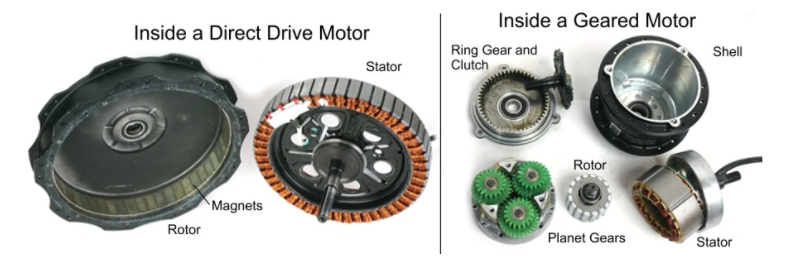
Figure 2.1 internal appearance of the motor
Note. Adapted from MagnTek,
http://www.magntek.com.cn/en/list/94/136.htm
Figure 2.2 Positioning of the speed sensor

Note. Adapted from MagnTek,
http://www.magntek.com.cn/en/list/94/136.htm
Having the speed sensor in the motor will constantly monitor the speed of the e-bike and also the pathway of the electrical impulse through the rotor. All these data would be collected and linked to the speed control system. As the pulse signal might be mixed with interference or disturbance from the environment or the magnets in the rotor, a filtering modulation process will proceed in the speed control system. The speed control system will detect and calculate the estimated rate and collect the data for multiple usages. For example, an LTA officer could easily track the pre-records of this particular e-bike during a routine check to check for speeding.
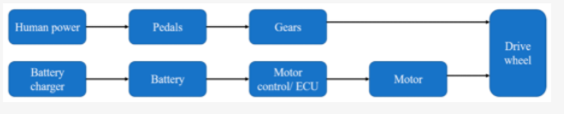
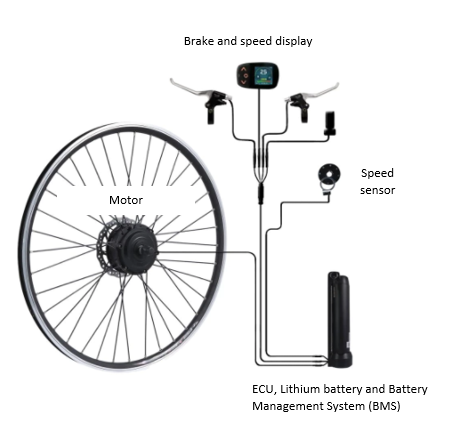
A speed control system in a simpler term is named the Electrical Controller Unit(ECU)or Multi-controller Unit (MCU). The ECU or MCU is an important component of an ebike, which controls the motor and monitor the status of the ebike( refer to figure 2.3 for the power train of an e-bike). The controller unit is located between the battery and the motor (figure 2.4). Several functions of the ECU control the bike's overall performance, including the motor speed, charging results, and motor charging quality.
Figure 2.3 Power train of an e-bike
Note. Adapted from Molecular Diversity Preservation International, Gihan Ekanayake et al.,2018, https://www.mdpi.com/1996-1073/11/10/2506/htm
Figure 2.4 Detailed layout of an e-bike system
Note. Adapted from Aliexpress, 2021,
https://www.aliexpress.com/item/32310583905.html
According to an article published on Molecular Diversity Preservation International (MDPI) in 2018 mentions that “The capacitors in the ECU assist in maintaining the supply of a steady consistent current, resulting in a smooth and improved lifetime of the driving motor”. Through the ECU, if the rider has exceeded the preset speed limit detected by the speed sensor, the supply power from the battery would be restricted and thus limiting the overall speed performance in an acceptable range. Data recorded by the ECU would be stored and only applicable to authorised personnel.
The full ESCS would allow the e-bike user to use without the fear of exceeding the speed limit by accident. Over the years, LTA has published many different rules and regulations regarding the illegal usage of e-bikes. For example, speed limitations, road usage and all motorised devices including e-bikes have to comply with the UL2272 fire safety standard.
Benefits of Proposed Solution
The use of ESCS is to control and monitor the speed of the e-bike. Speed management is one of the main factors for ensuring the safety of the e-bike user as it is important to not go beyond the speed limit to prevent any accidents from happening. Hence, it will be beneficial if both the stakeholders; LTA and e-bike seller are able to join hands and work together on this project. There are three main benefits of installing the ESCS.
Safety for the e-bike user and other road users.
Speed sensor in ESCS is able to monitor the speed of an e-bike and is able to ensure the safety of the user. According to an article from Reuters, a study shows that injuries to e-bike users are more serious compared to other users.
Installation of the ESCS help to ensure safety for the e-bike users as to when an accident occurred, the user will suffer more due to the different protection of the user and the material of the e-bike. Furthermore, the intensity of the injuries they suffered during an accident depends on the speed of the e-bike at that time. At the same time, the family and friends of the e-bike user need not be as worried for their safety.
LTA and e-bike sellers
ESCS will be beneficial to the LTA as the number of accidents related to e-bike speeding will decrease. The function of the cloud in ESCS will help to send the speed data of the users when the speed limit exceeds to LTA and LTA will analyse and come up with new ways to improve their current safety guidelines. Hence, increasing the effectiveness of the current safety guidelines. E-bike sellers are also able to promote their e-bike better with the installation of ESCS as the risk associated with e-bike will be greatly reduced.
Awareness for E-bike users
Implementing ESCS will increase the E-bike users' awareness. The E-bike users will be aware of their speed limits when riding the ebike. They will make sure to obey and follow closely the speed limits set as ESCS will alert the user if speeding takes place. Thus, overspeeding will not happen as the ebike users are vigilant about their speed.
Evaluation
4.1 Challenges
One main challenge that our proposed solution will face will be the implementation of the ESCS and the enforcement to ensure that e-bike users will not get it removed from their e-bike after the installation. As it would not be that realistic to get the ESCS on every single e-bike without a significant amount of time. Without strict guidelines and enforcement, the ESCS will not get properly implemented across all users and might end up as a waste of time.
Another challenge is to ensure proper maintenance and upkeep of the ESCS as if it were to malfunction or get faulty the user would not benefit from it. Routine inspection can be conducted to help ensure the ESCS is still working as intended as well as ensure that it has not been removed from the e-bikes
4.2 Limitations
The limitation of the ESCS is that despite being able to fulfill its intended purpose once installed, the most it will do is discourage e-bike users from speeding but limiting the speed and monitoring them. If the users choose to still disregard the guidelines and enforcement in place and remove the ESCS, then needless to say the ESCS would be useless in helping to ensure the safety of the user and those around them.
4.3 Alternative Solutions
Using Global Positioning System (GPS) to detect the speed of the e-bike
An alternate solution would be using GPS to track the speed of the e-bike instead of a speedometer. As if we were to use GPS instead, not only would the implementation be easier but it would be less taxing to maintain as well. The downside to using the GPS is that it would not be as accurate as of the speedometer.
Reference
Abdullah, A.Z. (2021, June 22). Singapore’s e-bike numbers doubled over the past year admit demand from food delivery riders. Channel News Asia.
https://www.channelnewsasia.com/singapore/e-bike-numbers-double-singapore-demand-food-delivery-riders-1944546
Awang, F. N & Heng, L.(2016, March 4). Teen motorised bicycle land on car windscreen after crash. The New Paper. https://tnp.straitstimes.com/news/singapore/teens-motorised-bicycle-land-car-windscreen-after-crash
Chander, V (2019, December 26). E-bikes show distinct pattern of severe injuries. Reuters.
https://www.reuters.com/article/us-health-ebike-injuries-idUSKBN1YT0MV
Cumming, T. (2018, June 8). How does an electric bike work? The Telegraph.
https://www.telegraph.co.uk/cycling/e-bike-revolution/how-does-an-electric-bike-work/
Ekanayake, G et al (2018, September 20). Numerical Study on Heat Transfer Characteristics of the 36V Electronic Control Unit System for an Electric Bicycle. MDPI.
https://www.mdpi.com/1996-1073/11/10/2506/htm
Joanne, P. (2019, November 11). LTA Rules for Bikes, Electric Bikes, E-Scooters & PMDs (2020). Money Smart. https://blog.moneysmart.sg/transportation/lta-rules-bikes-e-scooter-pmd/
King, C.C.S et al (2020, n.d). Injury patterns associated with personal mobility devices and electric bicycles. Singapore Medical Journey.
http://www.smj.org.sg/article/injury-patterns-associated-personal-mobility-devices-and-electric-bicycles-analysis-acute
Wei, T. (2020, January 9). 417 road accidents involving cyclists and e-bike users last year, slight drop from 2018. The Straits Times. https://www.straitstimes.com/singapore/transport/417-road-accidents-involving-cyclists-and-e-bike-users-last-year-slight-drop